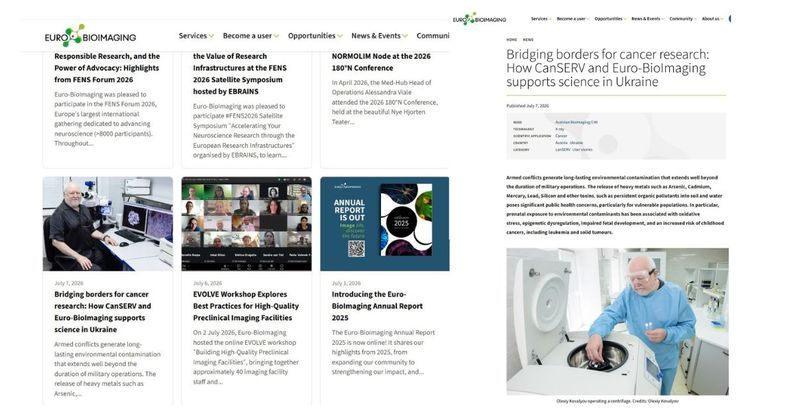
The official website of the European CanSERV project has featured the research of Professor Oleksii Kovalov, Head of the Department of Oncology and Oncological Surgery at Zaporizhzhia State Medical and Pharmaceutical University. The publication, “Breaking Borders for Cancer Research: How CanSERV and Euro-BioImaging Support Science in Ukraine,” demonstrates the international attention being paid to the work of Ukrainian scientists who continue to conduct world-class research amid the war.
The full-scale war poses not only immediate military threats to Ukraine but also long-term environmental challenges. Contamination of soil, water, and air with heavy metals, toxic substances, and other compounds may affect public health for many years to come. Studying the effects of such factors during pregnancy is particularly important, as the prenatal period is exceptionally sensitive to environmental influences. This is the issue being studied by Professor Oleksii Kovalov. In particular, his research focuses on the so-called “war exposome” — the totality of chemical, environmental, and other factors to which the population is exposed as a result of war.
An important stage was the use of advanced technologies of the European research infrastructure Euro-BioImaging, funded by the Horizon Europe programme. Thanks to the CanSERV project, archived placental tissue samples were studied in Vienna using advanced X-ray fluorescence spectrometry. This made it possible to quantitatively determine the presence and distribution of heavy metals in placental tissue and to establish where exactly and to what extent contaminants may accumulate.
The samples collected by Professor Kovalov in Zaporizhzhia were transported to Vienna, where they were processed and analysed by a team of researchers at the X-Ray Center of Vienna University of Technology. The data obtained are of considerable importance for further investigation of the potential relationship between exposure to toxic substances, placental health, and children’s health.
The research activity does not end there. The next stage will focus on assessing the health of children born in Zaporizhzhia during the war to mothers who had previously participated in the placental tissue study.
“After studying the contamination of placental tissue with heavy metals and persistent organic pollutants, our paediatricians, led by Professor Leonid Ovcharenko, will investigate the health of children born in Zaporizhzhia during the war to women who have already participated in our study. In this way, we are expanding the scope of our research,” explains Professor Oleksii Kovalov.
All women who participated in the study provided informed consent while still at the maternity hospital. “Studying the placenta is extremely important because the placenta is, in fact, a mirror of the health of not only the woman but also the child,” the researcher emphasises.
Thus, the research is gradually progressing from examining the exposure to contaminants itself to assessing its potential consequences for children’s health. Specialists from various fields are joining the research, laying the groundwork for a large-scale interdisciplinary study.
Participation in CanSERV has demonstrated the practical value of integrating Ukrainian researchers into European research infrastructure. The war in Ukraine is creating a new field for scientific research, the findings of which may be significant for European and global science as a whole and, in particular, may contribute to the development of new approaches to understanding cancer risk and its prevention.
The publication on CanSERV’s official platform once again demonstrates that research conducted by scientists at Zaporizhzhia State Medical and Pharmaceutical University forms part of the contemporary European scientific agenda. The experience gained through this project shows that, even amid the war, Ukrainian scientists continue to work in international teams, use advanced European technologies, and generate new knowledge with significance far beyond Ukraine.

26 Marii Prymachenko Blvd., Zaporizhzhia, 69035, Ukraine
Tel: +380 61 239 68 90
mail@mphu.edu.ua


